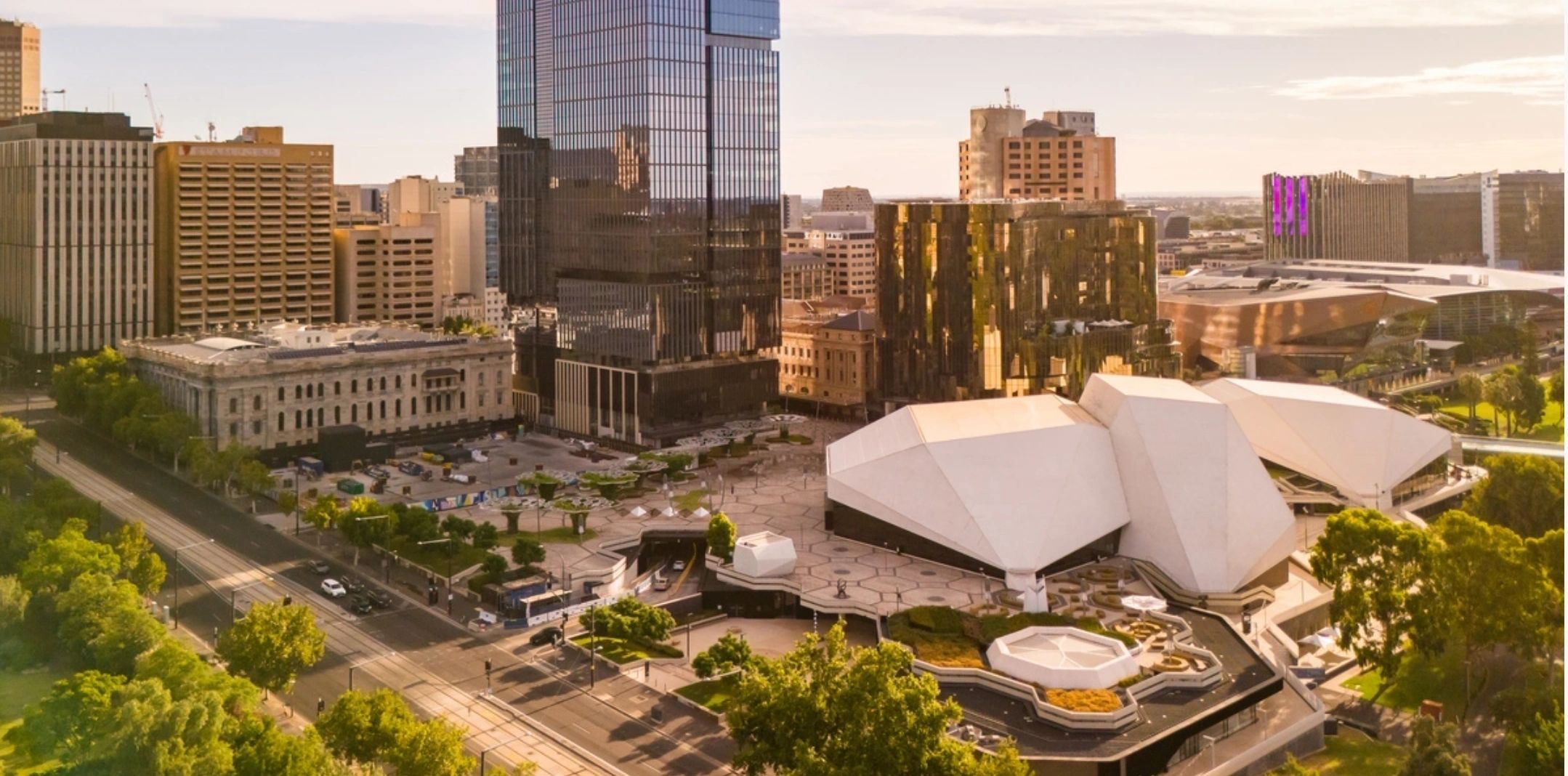
Adelaide, Australia
28 September – 2 October 2026
Festival Tower · North Terrace · Adelaide SA 5000

Organised by: Professional Electronic Warfare
Education Training and Research (PEWTER)
College of Science and Engineering · Flinders University
Expected cost ~$100 AUD per day · includes lunch, morning & afternoon tea
Student discounts available · Free for presenters
Contact alastair.wiegelmann@flinders.edu.au to discuss
Draft Conference Timetable
Times and sessions are indicative and subject to change.
Conference Overview
The Software Defined Radio Conference 2026 brings together academia, industry, defence, and the amateur radio community to share the work driving the field forward. As RF and spectrum engineering re-emerge as central disciplines, SDR sits at the intersection of advanced research and grass-roots experimentation — a domain where the amateur radio community and the broader citizen science tradition continue to shape the tools, techniques, and open infrastructure that the wider ecosystem depends on.
Now in its second year, the conference grew out of the inaugural Australian GNU Radio Days held at Flinders University in September 2025 under the GNU Radio Project’s sponsorship. It returns to Adelaide on 29 September – 2 October 2026, supported by the DST Group Chair of Electronic Warfare, Professor Sam Drake. The four-day program spans hands-on workshops and technical talks, and concludes with a Defence CLASSIFIED focused Electronic Warfare presentation.
Community & Heritage
The collaborative spirit of this conference rests on a long and serious tradition of scientific contribution from the amateur radio community. Organisations such as the American Radio Relay League (ARRL) and the Ham Radio Science Citizen Investigation (HamSCI) — working in partnership with NASA, the U.S. National Science Foundation, and university research groups — have turned the global network of amateur stations into a distributed sensing platform for ionospheric and space-weather science. Real-time and archival data from WSPRNet (the Weak Signal Propagation Reporter Network), the Reverse Beacon Network, and PSKReporter, generated by the routine operating activity of licensed amateurs, now underpin peer-reviewed studies of solar-flare HF radio blackouts, large-scale travelling ionospheric disturbances, sporadic-E characterisation, geomagnetic storm and solar-flare ionospheric impacts, and the ionospheric response to solar eclipses — including the coordinated 2017 and 2024 eclipse campaigns.
Much of this capability rests on the weak-signal digital protocols developed by Nobel laureate Joe Taylor, K1JT — developer of the WSJT and WSPR weak-signal modes — together with collaborators Bill Somerville (G4WJS), Steve Franke (K9AN), and Nico Palermo (IV3NWV). The resulting WSJT-X suite supports FT4, FT8, FST4, JT65, Q65, MSK144, WSPR, FST4W and related protocols, each optimised for a different propagation regime, and has made it routine to detect and log signals tens of decibels below the noise floor on standard amateur equipment. Projects such as the HamSCI Personal Space Weather Station, the low-cost Grape HF receiver, and the wideband TangerineSDR extend this further, building scientific-grade instrumentation around the same SDR principles that frame this conference. WSPRNet data has since been used to test propagation paths in ionospheric models including SAMI3, and to characterise the gap between empirical observations and predictive tools such as VOACAP. The Software Defined Radio Conference 2026 acknowledges this body of work as a foundational contribution to contemporary radio research, and welcomes its practitioners as full participants in the conversation.
Regional Contributions
Australia has been an active participant in this field for the better part of a century, and the work has pivoted decisively toward SDR-based instrumentation in the past decade. The Australian Space Weather Forecasting Centre — operated by the Bureau of Meteorology from offices in Adelaide, and successor to the Ionospheric Prediction Service founded in 1947 — runs the regional warning centre for the Australasian sector of the International Space Environment Service, and maintains a network of magnetometers, ionosondes, and solar observatories across Australia, New Zealand, and Antarctica. The University of Adelaide's Buckland Park field facility, with its long history of MF and HF ionospheric research, radar meteor work, and radio astronomy under Elford and Briggs, has more recently demonstrated the use of a VHF wind-profiling radar for observing objects in low Earth orbit, including the Chinese space station Tiangong-1, with potential application to total electron content measurements — an explicitly software-defined instrument repurposed for space-situational-awareness research. At DSTG Edinburgh, Dr Manuel Cervera, also Adjunct Associate Professor at the University of Adelaide, leads development of PHaRLAP, a Matlab toolbox providing 2D and fully magneto-ionic 3D numerical ray tracing for HF propagation in the ionosphere, now used internationally for over-the-horizon radar work and routinely validated against propagation data harvested from amateur SDR networks.
That citizen-science contribution is now almost entirely software-defined. The Wireless Institute of Australia, founded in 1910 and the world's oldest national amateur radio society, anchors a VK community whose stations are increasingly built around the KiwiSDR — a 14-bit wideband HF SDR by John Seamons (ZL/KF6VO) covering the entire 10 kHz–30 MHz VLF/LF/MW/HF spectrum at once, RX888 MkII direct-sampling receivers running KA9Q-radio, and Airspy HF+ Discovery units. Coupled to WSJT-X and to WsprDaemon, a Linux service that decodes WSPR and FST4W spots from one or more SDRs and uploads them to public databases such as wsprnet.org, recording additional information including Doppler shift and background noise level, a single Australian station with a single antenna can now simultaneously monitor every active HF band — feeding WSPRNet, the Reverse Beacon Network, PSKReporter, and VKLogger continuously. Australian-hosted SDR stations have supplied propagation observations to peer-reviewed studies, including the systematic study of 7 MHz greyline propagation between New Zealand/Eastern Australia and the UK/Europe using WSPR observations, and have participated in coordinated international campaigns such as the HamSCI Festival of Eclipse Science, where multiband KiwiSDR and RX888 receivers running WsprDaemon captured FST4W transmissions during the October 2023 eclipse to study D-region absorption, F2 critical-frequency response, and Doppler-shift signatures, alongside scientific-grade Grape and TangerineSDR instruments. The same SDR principles that frame this conference are also how the data is being gathered — and Australian contributors are visible at every level of the work, from defence research to backyard antenna.
Open-Source Framework
GNU Radio is the open-source signal-processing framework that turned software-defined radio from an expensive niche into a global movement, transforming whatever silicon you plug in — a $30 RTL-SDR dongle, a HackRF, a USRP, a SunSDR2 DX — into a programmable laboratory where the modem, the demodulator, the filter chain and the protocol stack are all just flowgraphs of signal-processing blocks connected together to describe a data flow. Started by Eric Blossom in 2001 around the original Ettus USRP, it has grown into the backbone of open-source signal processing and SDR innovation, powering research, education and products across countless domains for more than two decades, and now appears in thousands of scientific publications, university curricula, and dedicated conferences on multiple continents. The project is far from standing still: GNU Radio 3.10 brought first-class IIO/PlutoSDR integration, SoapySDR support and the foundational “custom buffers” architecture for accelerator I/O, recent 3.10.x releases are migrating GRC from GTK to a modern Qt front-end (gnuradio-companion --qt), and GNU Radio 4 — co-developed with GSI-FAIR for particle-accelerator instrumentation and shaped by the DARPA SDR 4.0 work — is rebuilding the runtime around a clean, modern C++ framework that emphasizes speed, predictability and maintainability, using type-safe APIs, lock-free buffers and compile-time optimizations under a permissive open-source license, with a custom buffer architecture supporting zero-copy paths to GPUs or accelerators, and early SYCL/CUDA prototypes demonstrating cross-device scheduling so that the same flowgraph that prototypes on a laptop can be deployed across CPUs, GPUs and FPGAs.
The real story, though, is what this ecosystem unlocks at the cheap end of the hardware spectrum: paired with an 8-bit RTL2832U dongle that was originally a DVB-T receiver, GNU Radio has put coherent multi-channel direction finding (KerberosSDR/KrakenSDR), passive bistatic radar using FM and DVB-T illuminators of opportunity, ADS-B and AIS reception, NOAA APT and Meteor LRPT weather-satellite imagery, GOES HRIT, hydrogen-line radio astronomy, GSM and LTE protocol research, and even passive atmospheric wind-sensing from 5 million ADS-B messages within reach of hobbyists, undergraduates and developing-world researchers — capabilities that a decade ago required six-figure rack-mounted receivers. That is the genuinely world-changing part: GNU Radio doesn’t just add value to SDR hardware, it inverts the cost curve of RF capability, so that the limit on what a $30 receiver can do is now set by the cleverness of the flowgraph rather than the price of the silicon.
Call for Presenters
This is a direct call to Australia’s RF, SDR and signal-capture industry to take a seat at the table. The sovereign capability already in this country is substantial — Australian-designed active phased-array radars deployed on Royal Australian Navy frigates and ground-based multi-mission systems; passive radar technology designed onshore and now exporting into international markets; specialist C4ISREW providers working alongside DSTG and the universities; HF skywave manufacturers that have kept Australia at the leading edge of long-range communications for decades; and the new wave of SDR-on-orbit payloads emerging from the country’s small-satellite sector. That capability rests on a deep bench of Australian-owned RF and antenna SMEs whose broadband HF arrays, EW and tactical antennas, low-PIM and mil-spec components, custom cable harnessing and bespoke RF subsystems are the unglamorous but essential plumbing of every fielded SDR system. The defence primes integrating that ecosystem in-country are the other end of the same supply chain.
The technical axes the conference puts on the table for 2026 are the ones currently reshaping the field: direct-RF-sampling converters and GaN front-ends collapsing the analogue chain; digital beamforming and active phased arrays migrating from naval apertures down into ground-vehicle and UAS-class form factors; cognitive and AI-enabled EW with ML inference pushed to the FPGA edge; open modular architectures — SOSA, MOSA, OpenVPX — and the heterogeneous CPU/GPU/FPGA compute models GNU Radio 4 is being rebuilt around; passive bistatic radar and illuminator-of-opportunity techniques; and space-based SDR payloads where Australian SMEs are punching well above their weight. If your team is building, integrating or fielding any of this — whether as a 5,000-person prime or a five-person specialist shop — the conference is where the work gets shown, the gaps get named, and the next pieces of the sovereign capability map get drawn.
Education
We are actively seeking presentations from universities and educators on how software-defined radio is being used in teaching. If your department has put SDR in front of students — whether in an undergraduate lab, a postgraduate research course, a signals and systems unit, or an extracurricular project — this conference is the right place to share that experience. We want to hear what is working, what the students are building, and what changed when SDR came into the curriculum.
Presentations on SDR in education might cover: how GNU Radio, MATLAB, Python or other platforms are being used to teach signal processing, communications, radar, radio astronomy or EW fundamentals; the hardware choices being made (RTL-SDR, HackRF, USRP, PlutoSDR, LimeSDR and others) and why; the practical advantages SDR brings over traditional lab equipment in terms of cost, flexibility and student engagement; specific experiments or projects that have been developed; and the challenges — software setup, hardware availability, assessment design — that others are likely to face. Comparative presentations across tools or institutions are especially welcome.
We want more Australian and New Zealand universities — engineering schools, physics and astronomy departments, and computer science groups — represented at SDR 2026. Bring your courses, bring your students, and bring the work you are already doing. Submit a presentation proposal through the Call for Presenters below.
Attend
We would love to hear from you. Register your interest and we will keep you informed as the programme develops.
Speak
We welcome presentations from industry, academia, defence, and the amateur radio community. Standard talks are 25 minutes; extended talks are 50 minutes. If your topic warrants more time, please let us know.
Venue & Contact
Conference Sponsor
PEWTER — the Professional Electronic Warfare Training, Education and Research Centre, a joint initiative of the Australian Department of Defence — through the Defence Science and Technology Group — and the College of Science and Engineering at Flinders University — currently runs the country’s only postgraduate EW program delivering teaching at NV1-gated depth, including classified training for our cleared student cohort, and we are actively seeking to grow that capability through collaboration and teaming with the broader sector. We want to expand that footprint and work alongside the broader sector, to the benefit of Defence and the country. The discipline is too important, and growing the talent pool through education is a national priority.
PEWTER is open to working with partners who share that commitment — willing to help, share knowledge, and develop the field together. The conference is the right place to begin those conversations.
Academic Leadership
The conference’s academic leadership comes from Professor Sam Drake — DST Group Chair of Electronic Warfare, Co-Director of Flinders University’s Centre for Defence Engineering Research and Training (CDERT), inaugural Flinders University Chair of Electromagnetic Systems and Security, and the academic anchor of PEWTER.
Sam’s path into the EW chair is unusual and unusually well-suited to the discipline. His PhD, undertaken with the Mathematical Physics group at the University of Adelaide, was on axisymmetric space-times in general relativity; a post-doctoral position at the University of Padua extended that work to relativistic dynamics around rotating compact stars. He then joined DSTO/DSTG as a Defence scientist, where he represented Australia as a subject-matter expert in government-to-government collaborations with Canada, New Zealand, the United Kingdom and the United States, and worked alongside Raytheon and Boeing on the electromagnetic security systems of Australian fighter aircraft.
For an SDR audience the published work is squarely on point: gravitational time-dilation effects on GPS satellites — the foundational physics underpinning every GNSS-disciplined SDR receiver and coherent multi-channel timing chain — alongside single-channel direction-finding algorithms combining pseudo-Doppler with MUSIC, discrete probability-map representations for distributed-sensor emitter localisation, and autonomous UAV-based EW sensor and effector systems.
His current research at Flinders sits under the banner of Spectrum Security: ensuring that information transmitted by electromagnetic waves reaches its intended recipients uncorrupted, in an environment where increasing parts of that spectrum are contested. That arc — from general relativity through satellite navigation, emitter geolocation and operational EW to spectrum security — is exactly the cross-disciplinary range the discipline now demands, and it is the reason PEWTER’s curriculum sits where it does.
Sam was a co-organiser of the inaugural Australian GNU Radio Days in 2025 and remains the academic lead for the SDR Conference 2026.
Postgraduate Study
Flinders University offers dedicated postgraduate programs in Electronic Warfare. Advance your career with industry-recognised qualifications.